Sewer Line Excavation and Lateral Replacement in Richmond
Key Takeaways: What Your Sewer Pipe Is Made Of Decides the Repair in Richmond
- A line that fails, gets cleared and fails again in the same place has a material or a structural problem, and cleaning cannot correct either one.
- Housing in Richmond spans a wide range of eras, so four different lateral materials sit under one territory and each one fails in its own way.
- Vitrified clay, the standard under the older Richmond streets, is sound pipe with a joint every few feet, and roots from the mature canopy work into those seams.
- Bituminous fiber conduit, used through the postwar suburban build-out, deforms out of round as it ages, and a pipe that has lost its shape cannot be lined.
- Cast iron corrodes and scales from the inside, while later plastic pipe usually fails at a belly or a crushed spot instead of by decay.
- Camera inspection identifies which of those you have, and that answer decides whether trenchless is on the table before anyone quotes a method.
- Roto-Rooter is fully licensed and insured, handles permits and inspection, and provides an on-site estimate before any work begins.
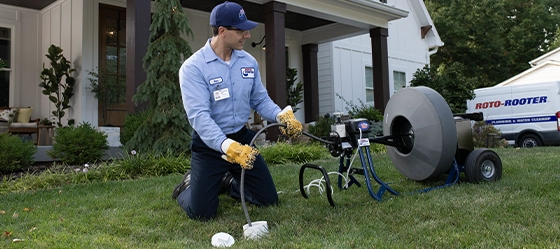
Two houses a mile apart in Richmond can need completely different sewer work for the same symptom, and the reason is usually the pipe itself. Richmond grew in long, distinct waves, and every wave buried the material that was standard at the time. The older streets north and south of the James River carry vitrified clay. The suburban ring that filled in afterward carries a mix that includes bituminous fiber conduit. Newer construction is plastic. Each of those ages differently, fails differently, and responds to a different repair, which is why a serious answer on this service starts with identifying what is actually in the ground.
Material Comes First on Any Sewer Line Excavation
A camera inspection does more than confirm there is a problem. It shows the pipe wall, the joint spacing, the shape of the bore and the way the defect has formed, and an experienced eye reads the material off those things. That matters because the material determines which repairs are physically possible. Lining needs a host pipe that is continuous and close to round. Bursting needs a pipe that will fracture predictably and ground that will accept the displaced material. A pipe that has already flattened into an oval offers neither.
How do I find out what my sewer lateral is made of?
The camera is the direct answer, and the age of the house is a useful first guess. Clay joints appear at regular intervals with a visible collar. Fiber conduit shows a smooth, dark wall that goes soft and out of round, sometimes with the layers separating. Cast iron shows scale and tuberculation narrowing the bore. Plastic looks clean and continuous, which is why a failure in plastic is nearly always mechanical: a sag, a crushed section, or a joint that was never seated. None of that can be settled from the surface, and guessing from the address alone leads people to buy the wrong repair.
The ground adds a second variable. Richmond sits on the fall line of the James River, where the hard crystalline rock of the Piedmont gives way to the sands, gravels and clays of the coastal plain, and those two materials behave differently around a buried pipe. West of the line a trench can meet rock at shallow depth. On the terraces east and south of it the material is looser and drains faster, so an escaping leak shows less at the surface and a trench wall needs more attention. Winters in Virginia are mild enough that frost depth is not what set how deep your lateral sits, so the depth in the yard reflects an old decision about the fall to the main.
Four Materials Under One City, and Four Ways They Fail
Clay is brittle but chemically durable, so a clay lateral in Richmond can be in good condition apart from its joints, where roots from the street trees that shade the older blocks have found a seam. Fiber conduit is the opposite case: the wall itself gives up, and the failure is progressive along the run instead of sitting at one point. Cast iron narrows and eventually perforates. Plastic mostly fails where the ground under it moved or where something crossed over it. Richmond has all four in service at once, which is why the answer that suited a neighbor two streets over can be the wrong answer for your line. Those four stories lead to four different conversations about scope.
- One joint gone in sound pipe: a spot repair, with the trench opened only across that section.
- Roots through several joints along a clay run: cleaning buys time, and a full sewer line replacement is the durable answer.
- A wall that has deformed along its length: replacement, since there is no sound host pipe left for a liner to sit inside.
- A belly in otherwise good pipe: the bed under the pipe is the problem, so the repair has to reach the ground rather than the pipe.
If the line is blocked but structurally sound, none of this applies and the cheaper answer is the right one. Drain cleaning in Richmond handles the lines that are dirty instead of broken.
Operated as an Independent Contractor - All available services, hours of operations, pricing structure, and guarantees may vary by location
Serving the entire Richmond metro area, Including:
Counties in the Richmond Area
Who Answers for the Lateral Once It Leaves the Property
The sewer lateral is the private pipe running between the building and the public main. The usual arrangement is that the property owner is responsible for the lateral and the public utility is responsible for the main, but where responsibility changes hands is set by local ordinance and is genuinely different between jurisdictions. Some carry the owner to the connection at the main, others stop at the curb or the property line, and both patterns exist in Virginia. Richmond property owners should have that confirmed for their own address, and the crew does exactly that before scoping the repair. Roto-Rooter works the private side. Main work under the street belongs to the utility that owns it and we do not take it on.
Excavation, Backfill and the Surface You Get Back
Once the footage justifies the dig, the run is marked, the utilities are cleared, and the ground opens across the length that was established rather than along the whole property. The failed pipe comes out, the bed is prepared, the new line is laid to grade and tested, and a cleanout goes in where the next crew can reach it. Backfill goes back in compacted lifts so the trench line does not settle through the following seasons. Across turf that means a restored grade. Across concrete or brick it means a saw cut and a patch. Landscaping and decorative hardscape rebuilds sit outside the scope, and what is included for your property is agreed on site and written down before the work starts.
Keeping the Household Running Until the Work Is Booked
Permitting and scheduling take time and a house still has to function. Roto-Rooter is available 24/7, 365 days a year, and a crew can keep a failing line moving in the meantime. If waste is backing up right now, emergency plumbing in Richmond is the faster route, and where a backup has already put water into flooring or drywall, water damage restoration in Richmond takes over the cleanup. The rest of what we do in this market is on the Roto-Rooter page for Richmond.
Request an Inspection Before Anything Is Quoted in Richmond
Roto-Rooter has been working on sewers and drains since 1935, and the plumbing peace of mind on a job of this size comes from knowing what is in the ground before anybody breaks it. If a line in Richmond has been cleared more than once and keeps coming back, the useful next step is footage. Call 804-794-7474 to put a camera down the line, or schedule online, and you will have an on-site estimate before any work begins.

When Lining Works, When Pipe Bursting Works, and When Excavation Is the Only Answer
Utility Locating, Permits and the Street Above the Line
