Sewer Line Replacement and Excavation in Arvada
Key Takeaways: A Deeper Trench Changes Every Other Decision
- Repeated backups after a line has been properly cleaned are a structural signal, and repeating the cleaning is paying twice for the same few months.
- Buried lines sit deep here because frost says they must, and depth drives the shoring, the spoil and the size of the machine long before anybody talks about method.
- Because the line is deep, guessing is expensive. A camera inspection is the cheapest thing that happens on this job and the only thing that identifies the cause.
- Cobble and gravel along the creek terraces cut slowly and do not hold a clean trench wall, which is a safety consideration rather than an inconvenience.
- Pipe bursting and lining reduce the opening but are conditional on depth, pipe condition and access at both ends. The footage decides, never the sales conversation.
- An irrigated Front Range lawn takes real work to re-establish after a trench, and sprinkler lines crossing the run get found the hard way if nobody looks for them first.
- Roto-Rooter locates utilities before any excavation, handles permitting and inspection, is fully licensed and insured, and answers 24/7, 365 days a year.
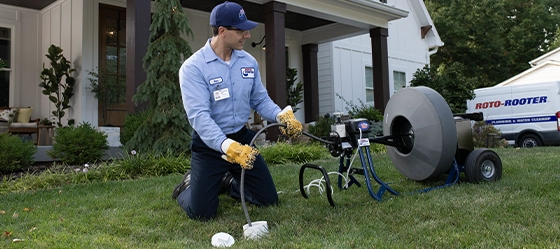
The first thing worth knowing about a sewer excavation in Arvada is how far down the work happens. Buried lines in Colorado are set below the frost line, which puts a residential lateral considerably deeper than the same pipe in a warm-weather market, and depth is the variable that quietly sets everything else: how wide the trench has to be opened at the top, how the walls are supported, how much material comes out and has to go somewhere, and what size of machine can get to the run in the first place.
Why Depth Makes the Camera Worth More Here
In a market where a line sits shallow, a small exploratory dig is a reasonable way to find out what is going on. Here it is not. Reaching a deep lateral to look at it costs most of what reaching it to fix it costs, so exploratory digging is close to the worst available way to gather information.
A camera inspection removes that problem entirely. It travels the run, records the condition along its whole length, and locates any defect precisely enough that a trench can be put in the right place the first time rather than opened and extended. On a deep line that precision is not a refinement, it is most of the value.
What Ends the Cleaning Option
Cleaning restores a line that is intact and obstructed. It cannot help a line whose shape is the problem. The conditions that move a run out of the cleaning category are a section that has failed and lost its bore, lengths that have separated or shifted against each other, a stretch that has settled into a dip and holds water permanently, and root growth entering through a break rather than merely occupying a pipe.
Each of those has the same tell from inside the house: the line clears, then behaves badly again on a predictable schedule. The difference between them only shows up on footage, and the difference decides whether you are looking at one length of pipe or the whole run.
Serving Arvada and surrounding communities, Including:
Counties in the Arvada Area
Everything Buried Gets Marked Before Anything Gets Cut
Utility locating happens before excavation, without exception. Gas, electric, water and communications all occupy the same corridor a sewer lateral does, and a deep trench crosses more of them than a shallow one. On residential property there is usually a second layer nobody thinks about: irrigation mains and lateral sprinkler lines, which are not on any locate ticket and which a trench across a Front Range lawn will find. Walking the yard and marking heads and valve boxes before the machine arrives saves an argument later.
Permits, Inspection, and the Figures Not Printed Here
Sewer excavation is permitted work and it is inspected, and Roto-Rooter handles that process as part of the job rather than leaving it with the homeowner. You will not find a permit fee or an approval timeline anywhere on this page. Both vary by jurisdiction and by the scope of the specific job, and publishing either would be making a commitment on somebody else's behalf. Roto-Rooter provides on-site estimates before any work begins, and permitting is scoped inside that.
Where the Private Line Stops
As a general matter the property owner is responsible for the lateral that serves the building and the local authority is responsible for the public main. Where that responsibility transfers, at the property line, at the curb, or at the tap itself, is a local rule and it genuinely differs between jurisdictions in Colorado. Confirm it with your provider rather than reasoning from what happened at somebody else's house, because it decides who pays and it is the most common surprise on a job like this one.
Roto-Rooter works on the private side of that line. Work on the public main is not something a plumbing company undertakes, so an inspection pointing past the connection means the next call goes to the municipality.
Putting an Irrigated Yard Back Together
This is where expectations need setting honestly. A trench across a lawn in Arvada leaves a scar that takes a full growing season to disappear even when everything is done well, and re-establishing turf in a semi-arid climate needs water at a time of year when watering may be restricted. Where the run passes under a driveway, a walkway or a patio, that surface is cut and the repair will be visible.
Backfill and compaction are included in the work, and compaction deserves the attention because poorly consolidated backfill in coarse material settles for months afterward and leaves a depression along the trench. Any sprinkler line cut during the dig is repaired as part of putting the yard back, and final surface work such as sod, planting or paving is scoped on site and written into the estimate rather than assumed.
Spot Repair, or the Whole Run
Where footage shows one failed length in a line that is otherwise sound, opening only that section is the proportionate answer and a considerably smaller job. Where it shows the same defect repeating along the run, it is not, because a short repair in a line that is failing generally means a second excavation in the same yard. Depth raises the stakes on that decision, since mobilizing twice for a deep trench is the expensive outcome the footage exists to prevent.
If the line backs up while the repair is being scheduled, emergency plumbing help in Arvada can restore flow temporarily so the household keeps running. That is a holding action and it changes nothing about what the camera found. For everything else Roto-Rooter handles locally, start at Roto-Rooter in Arvada.
Schedule a Sewer Camera Inspection in Arvada
Roto-Rooter has worked on sewer lines since 1935, is fully licensed and insured, and answers 24/7, 365 days a year across Arvada and the Colorado Front Range. Call Roto-Rooter or call 303-571-2024 or schedule online to get the line inspected before anybody talks about digging. Roto-Rooter provides on-site estimates before any work begins, so the footage and the scope arrive together. On a trench this deep, deciding from evidence is the plumbing peace of mind worth paying attention to.

Pipe Bursting, Lining or an Open Cut?
Cobble, Claystone and a Line Set Below the Frost
