Hydro Jetting in Manhattan
Key Takeaways: When One Line Serves Forty Apartments
- A backup in a building is rarely one tenant's problem. Stacks and house drains are shared, so a restriction anywhere shows up in whichever fixture sits lowest.
- Cabling opens a channel through a blockage. The grease or scale bonded to the pipe wall stays where it was, which is why the same line closes again.
- High-pressure water scours the full circumference, so what leaves the building is the buildup rather than a plug through the middle of it.
- Cast iron of the age common in this housing stock narrows from the wall inward, gradually enough that nobody notices until a fixture backs up.
- Grease is the other driver, and the density of commercial kitchens here makes it a different problem from the residential kind.
- The camera goes down first. It rules on whether older pipe can take the work at all.
- Roto-Rooter is fully licensed and insured and answers in Manhattan 24/7, 365 days a year.
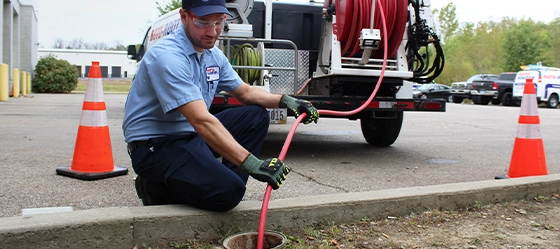
The plumbing question that dominates in a vertical city is not really about drains, it is about sharing. A single-family house has its own line to the street and a problem in it belongs to one household. A building has a stack running the full height of it, house drains collecting at the bottom, and a connection out. Everything above shares everything below, so a restriction somewhere in the middle presents itself as a backup at whichever fixture happens to sit lowest, which is frequently nowhere near the actual problem.
Why Cabling Buys Less Time in a Stack
A drain cable is a boring tool. In a Manhattan stack it cuts through what is stopping the line and restores flow, and in an occupied building at eleven at night that is precisely what is needed. What it leaves is the layer coating the inside of the pipe on either side of the opening it made. In a house that layer rebuilds at the pace of one household. In a stack serving dozens of units it rebuilds at the pace of all of them, which is why the interval between emergency calls in a building shortens in a way that feels unreasonable to the people paying for them.
What the Pressure Does
A Manhattan jetting hose carries a nozzle directing water backward against the pipe wall as the hose is drawn through. The action is a scour across the whole inner surface rather than a bore through the center. Hardened grease comes off. Sludge settled in a horizontal run at the base of a stack is flushed out instead of pushed along. Mineral scale in older cast iron is cut back toward the original bore. Roto-Rooter treats cleaning to the pipe wall as the standard rather than as an upgrade, and in a shared system that distinction is the difference between a callback next quarter and a line that holds.
Serving the entire Manhattan metro area, Including:
Counties in the Manhattan Metro Area
Older Pipe Sets the Limit
High-pressure water assumes the pipe can take it, and in Manhattan that assumption gets tested harder here than in most places, because so much of the material is old. Cast iron thinned by decades of corrosion may not survive the work, and the camera is what establishes that before anyone finds out expensively in an occupied building. A section that has already failed has no bore to clean. A badly displaced joint will catch the hose and is pointing at a repair regardless.
In any of those cases the honest answer is that cleaning is not what the line needs. What follows is a repair conversation, and in a building that conversation involves the managing agent as much as the plumbing, because access and scheduling across occupied units are half the problem.
Access Is the Real Constraint
In a house, jetting happens at a cleanout in the yard. In a Manhattan building it happens wherever access exists, which may be a cellar, a service area, a stack cleanout on a landing, or a fixture that has to be pulled. Coordinating that across occupied apartments is genuinely the harder part of the job, and it is worth raising when you call rather than discovering with a technician standing in a lobby.
Where a Manhattan building has no usable cleanout, the inspection covers what installing one would involve. On a shared line that has already needed attention more than once, it pays for itself quickly: every future visit is shorter, less intrusive to residents, and the camera can reach further.
Who Pays, and Why It Gets Argued About
The shared nature of a Manhattan system creates a question that does not arise in a house: the backup appeared in one unit, but the restriction is in a line everyone uses. Whether that is a resident's cost or the building's usually turns on where the problem actually sits, and the camera is what answers it. A blockage inside a unit's own branch is one thing. A restriction in the stack or the house drain below is the building's system.
This is a practical reason to have the footage rather than a technical one. A recorded inspection settles an argument that otherwise runs on assertion, and in a Manhattan building where a super, a managing agent, a board and a resident may all have a view, having something objective on a screen shortens the conversation considerably.
Buildings That Move to a Schedule
The New York managing agents and supers who stop having plumbing emergencies are generally not the ones who found a better plumber. They are the ones who stopped waiting for the failure. A first inspection establishes the condition of the system, that becomes a baseline, and cleaning moves onto a planned interval adjusted once everyone can see how quickly the line fouls.
The economics are different from a house for a simple reason. An emergency in a building is not one inconvenienced household, it is multiple units affected, a super called out, and sometimes a commercial tenant unable to trade. The cost of the visit is the smallest part of it.
Restaurants Sitting Under Apartments
A commercial kitchen at street level connected into the same building system is a category of its own. It produces cooking waste daily at a volume no household approaches, and that waste cools and hardens in the horizontal runs it passes through. When those runs are shared with residential units above, a restaurant's accumulation becomes everybody's problem, and the backup surfaces in whichever fixture sits lowest rather than in the kitchen that produced it.
That arrangement is common enough in Manhattan to be worth planning around explicitly. Grease interceptor service handles what leaves the kitchen. Jetting handles the run itself, and the interval it needs is a question about that kitchen's volume rather than a number that applies to every building in New York. Buildings that treat the commercial tenant's line as part of the building's maintenance schedule tend to have far fewer arguments about it later.
What a Visit Involves
A Manhattan technician establishes access, runs the camera, and goes through what is on the screen before anything else. If the line is a candidate the hose goes in and the run is cleaned through, and the camera goes back down at the end. A before-and-after on the same line is the only honest way to show a wall is actually clear, and for a building it is worth keeping as a record. Roto-Rooter provides on-site estimates before any work begins.
If a line is backing up right now, start with emergency plumbing help in Manhattan. Flow comes first and the cleaning conversation follows. Everything else handled locally is on the Manhattan service page.
Book an Inspection
Roto-Rooter has served New York property owners, boards and managing agents since 1935 and is fully licensed and insured. Call 212-687-1662 or schedule online to find out what is actually in the line rather than clearing it again. That is the plumbing peace of mind worth having in a shared system, and Roto-Rooter answers 24/7, 365 days a year.

Signs the Problem Is the Shared Line
Old Iron in Buildings That Never Empty

SPECIAL FINANCING AVAILABLE
We have partnered with Synchrony Bank to offer financing options to make your plumbing repair expenses as convenient and stress-free as possible.