Sewer Line Excavation, Repair and Replacement in Arlington
Key Takeaways: The Pipe Under an Arlington Street Depends on Its Decade
- Repeat blockages in one spot: a line that keeps failing at the same point has a defect in the pipe, and the camera identifies both the defect and the material it is in.
- Four eras of building: Arlington grew in overlapping waves, so vitrified clay, cast iron, early thin-wall plastic and modern PVC all exist here under different streets.
- Material sets the options: clay fails at its many joints, cast iron corrodes and scales from the inside, and early plastic deflects, and each of those points at a different repair.
- Sandy ground changes the dig: the loose post oak soil across much of Texas west of the prairie line will not stand up in an open cut, so shoring and bedding are part of the plan rather than an extra.
- Cleaning first where cleaning works: a sound pipe carrying grease or scale is a jetting job, and excavation is reserved for a pipe that has lost its structure.
- Utility locating is mandatory: gas, electric, water and telecom are marked before any trench is opened.
- The lateral is yours, the main is the city's: your municipality sets the point where that responsibility changes hands.
- Roto-Rooter is fully licensed and insured, pulls the permit, arranges the inspection and backfills and compacts the trench when the work is signed off.
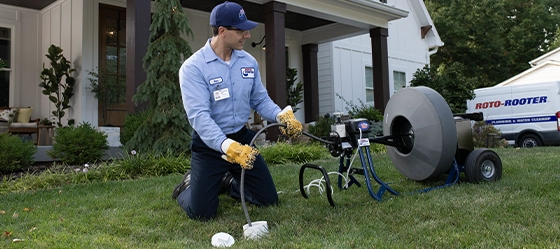
An address in Arlington will not tell you what is buried under it. Two houses four miles apart in this Texas city can sit over pipe laid two generations apart, in two different materials, failing for two unrelated reasons. That is the first thing worth understanding before anybody talks about a dig.
Arlington did not grow in a single push the way the newer suburbs around it did. There is an older residential grid near the original core and around the university campus, a very large mid-century expansion that came with manufacturing and with the entertainment and stadium district, later subdivisions filling the gaps, and new construction still going in on the southern and western edges. Each of those waves was piped with whatever was standard at the time, and all of it is still in the ground.
So the camera in Arlington has two jobs, and identification is the first of them. A camera inspection run from the cleanout tells the crew what the pipe is made of, how long the individual lengths are, where the joints fall and how the material is behaving, and only then what has gone wrong. Everything downstream of that, whether a liner is possible, whether a bursting head will pull cleanly, how wide the trench has to be, follows from the answer.
What the Material Tells You
- Vitrified clay: short lengths and a great many joints, and roots find those joints. Root intrusion at a cracked hub is the classic failure and it comes back after cutting unless the joint is dealt with.
- Cast iron: corrodes from the inside, scales, and channels along the invert until the bottom of the pipe thins and gives way. A cable passes and the flow still slows, because the bore has closed in. It is a common finding under the mid-century streets in Arlington.
- Early thin-wall plastic: strong enough when it went in, and prone to deflection and to settling into a bellied line where the bedding was thin.
- Bituminous fiber conduit: occasionally the camera finds it in a postwar run. It softens and deforms into an oval, and nothing goes inside it that will hold its shape.
- Modern PVC pipe: usually sound, with any trouble at a gasketed joint or at a transition to older pipe near the connection.
A sound pipe that is simply fouled has a cheaper answer than a machine in the yard. Grease, scale and soft buildup in a structurally intact line respond to hydro jetting in Arlington, and routine blockages are handled by drain cleaning in Arlington. Excavation belongs to the cases where the pipe itself has stopped being a pipe.
Serving Arlington and surrounding communities, Including:
Counties in the Arlington Area
What Makes Sewer Line Replacement the Better Option Here?
The threshold is structural. A pipe that has kept its shape and its fall can be cleaned and put back into service, and that remains the cheaper and less disruptive path for as long as it holds. Once the wall is gone, once the joints are open to soil, or once the run has settled out of grade, cleaning buys time and nothing more.
In an older Arlington neighborhood the trigger is usually cumulative: a clay line with roots at several joints, cleared repeatedly, where the camera now shows displaced hubs and soil washing in. In mid-century stock it is usually corrosion, with the invert thinned out and the bore closing. In the newer parts of the city it is far more likely to be a single defect worth a spot repair. Same service, three different jobs.
Cost varies with the length of the run, its depth, the material, what is on the surface and the method the inspection supports, and Roto-Rooter provides on-site estimates before any work begins. There is no shortage of work this team does across the city, and the Arlington plumbing page sets out the rest of it.
Book a Camera Inspection Before Any Excavation in Arlington
Call Roto-Rooter at 817-482-9008 and ask for a camera inspection of the lateral, or schedule online. Crews are available 24/7, 365 days a year, Roto-Rooter is fully licensed and insured, and every dig starts with an on-site estimate and footage you have seen. Knowing what is under the yard in Arlington, Texas, before anyone opens it is most of the plumbing peace of mind on a job this size.

Pipe Material Decides Between Excavation and a Liner
Sandy Ground, Shored Trenches and Utility Locating
