Sewer Line Excavation and Replacement in Rock Hill
Key Takeaways: The Sewer Line Is Not the Only Thing Buried in That Yard
- A line that keeps closing after it has been cleaned has a structural fault, and a camera inspection is what confirms it and puts a distance on it.
- Before a machine touches the ground, the corridor between the house and the street gets located and marked: gas, electric, water and telecom all share it.
- A public utility locate covers the lines the utilities own, and it stops at the meter. Irrigation, a pet fence, low-voltage lighting and a gas run out to a grill are yours, and nobody is coming to mark them.
- Red Piedmont clay closes over an old trench so completely that a yard in Rock Hill keeps no visible record of what has been buried in it, so the household's own memory is part of the survey.
- What the marks show decides where the trench opens, where a trenchless entry pit can sit, and where the machine gives way to a shovel.
- Trenchless is conditional. Lining needs a continuous host pipe and bursting needs ground beside the pipe that will yield, and the inspection is what settles which applies.
- Roto-Rooter handles permits and inspection, backfills and compacts in lifts, and provides on-site estimates before any work begins.
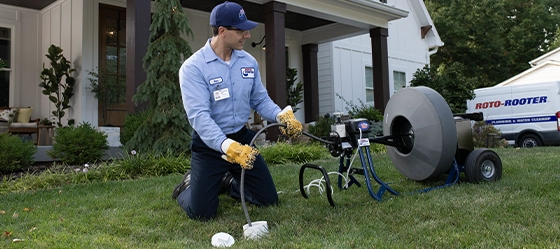
Everybody in Rock Hill imagines this job as a machine and a trench. The part that actually shapes the day is quieter and happens first: somebody walks the ground with a locator and paints it. Between the wall of a house and the main in the street runs a corridor a few feet wide carrying the gas service, the electric feed, the water service, telecom, and the sewer lateral that brought you to this page. Rock Hill has been building steadily for a long time, first as a Carolina Piedmont mill town and more recently as one of the fastest growing parts of York County, and a corridor that has been added to across that whole span is a crowded one.
There is a limit to the marking that catches people out. A public utility locate marks the lines the utility companies own and it ends at the meter. Everything past that point belongs to the property owner and is not on anybody's map: the irrigation zones, the buried pet fence, the landscape lighting run, the gas line somebody took out to a grill or a pool heater, the water line to a shed. A crew that hits one of those has hit something the owner paid for, and it is avoidable with a conversation.
The ground itself makes that conversation matter more here than it would elsewhere. Red clay backfills tight and grass closes over it within a season, so a lot in Rock Hill that was trenched for irrigation four owners ago looks exactly like a lot that never was. There is no scar to read. What the household remembers, and what the previous owner mentioned when they sold, is genuine survey information.
Do I need to have my yard marked before a sewer repair?
Yes, and arranging it is the crew's job. Utility locating is a legal step and a safety obligation on any excavation, and no reputable company treats it as optional or as paperwork. What you can add to it is the private half: tell the plumber what has been put in the ground since the house was built, and walk the yard with them so the sprinkler heads, the meter, the cleanout and the low points all get pointed at before a scope is written.
Operated as an Independent Contractor - All available services, hours of operations, pricing structure, and guarantees may vary by location
Serving the entire Rock Hill metro area, Including:
Counties in the Rock Hill Metro Area
What the camera has to find before any of this matters
Excavation is the repair of last resort, so the first job is proving it is warranted. A camera goes down the line and looks for the conditions cleaning cannot correct: a collapsed section, an offset joint where two lengths no longer meet, a belly holding standing water and catching solids, or root intrusion through a broken joint that returns as fast as it is cut. If the line clears and stays clear, drain cleaning in Rock Hill is the right service and nothing needs to be dug.
The other line in that corridor
The water service runs through the same strip of ground as the sewer lateral on most Rock Hill properties, and it is worth a word because it is found in a completely different way. A sewer line is inspected from the inside with a camera. A pressurized water service cannot be, so a leak on one is identified by the meter turning with every fixture closed, by pressure that has fallen off, or by a wet patch that surfaces somewhere other than the break, which is exactly what clay soil encourages it to do.
When a trench is going in anyway, that is the moment to ask about the condition of the water service, because opening the same ground twice in two years is nobody's idea of a good outcome. The crew will tell you what they can see and what would need testing, and they will not sell you a second excavation on a hunch.
The lateral, the main and where responsibility changes
The sewer lateral is private pipe serving one building. The public main belongs to the municipality. The point where responsibility passes from one to the other is set by local rule and differs between jurisdictions, so the crew confirms it for your address instead of quoting you a rule from another town. Roto-Rooter works on the private side of that line, and municipal main work belongs to the utility that owns it.
Permits, inspection and putting the ground back
Work of this kind is permitted and inspected in Rock Hill and across South Carolina, and Roto-Rooter carries that process on your behalf. What the process involves varies by jurisdiction, so the specifics for your address are covered during the on-site estimate instead of being promised in advance on a web page.
The trench is backfilled in lifts and compacted, and the pipe is bedded so it is supported along its length. Clay spoil does not go back the way it came out, so some settlement along the run over the following season is normal ground behavior in this part of South Carolina. Sod, plantings, a driveway apron or a section of walk are scoped on site and agreed before work starts, and if an irrigation line has to be cut and rejoined to reach the sewer, that gets said out loud in advance too.
If the line closes completely while the repair is being scheduled, an emergency plumber in Rock Hill can get the household usable again, and the Rock Hill plumbing page covers the rest of what the local team does.
Book a Sewer Line Excavation Estimate in Rock Hill
Call 803-684-0082 to get the line inspected, the ground located and a real scope written, or schedule online at a time that suits the household. Roto-Rooter answers 24/7, 365 days a year. Cost varies with the length of the run, the depth, the access and the method the inspection supports, and Roto-Rooter provides on-site estimates before any work begins.

Sewer Line Excavation Starts With Paint on the Grass
What the Marks Change About Open-Cut and Trenchless
