Sewer and Water Line Excavation in New York
Key Takeaways: What Excavation Fixes and What It Cannot
- A backup that shows up in heavy rain and never at any other time is behaving differently from a failed pipe, and the difference is worth establishing first.
- Much of New York drains through a combined system, where one main carries street runoff and household waste, so what happens outside the property line matters.
- A camera inspection is what settles it. A survey distinguishes a run with a structural defect from a sound run being asked to discharge into a main that is temporarily full.
- Four findings genuinely call for replacement: a collapse, a severe offset, a belly holding water, and roots or soil arriving through a break.
- Trenchless stays conditional. Pipe bursting and lining depend on depth, host pipe condition, degree of collapse and usable access at both ends.
- Utility locating precedes any excavation, and in this city the ground beside a lateral is unusually busy, so the step takes time rather than being waived.
- The work is permitted and inspected and Roto-Rooter runs that process. Roto-Rooter is fully licensed and insured.
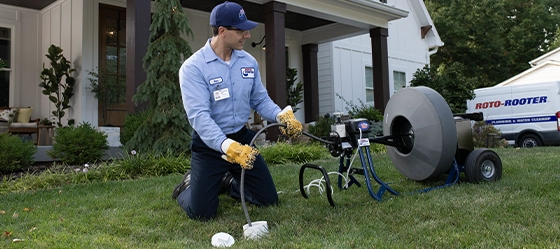
Digging is expensive, disruptive, and sometimes exactly right. What this page is really about is the step before it, because a New York property can produce a convincing sewer backup without having a damaged pipe anywhere on it.
Does a Sewer Line Back Up Only When It Rains?
If the answer is yes, that pattern is evidence in itself. In much of the city the main in the street carries stormwater and sanitary flow in the same pipe. During a heavy downpour that main runs full, and while it is full a house connection discharging into it has nowhere to send anything. Water finds the lowest fixture on the property instead.
A sound pipe behaves that way. So does a damaged one, which is the problem, and it is why a rain-only backup is worth investigating rather than assuming either way. The distinguishing question is what the line does the rest of the time. A run that also slows in dry weather, that reloads within weeks of a thorough cleaning, or that has been cleared three times in two years is reporting something about itself. A run that behaves perfectly for months and then fails during a storm is reporting something about the system it discharges into.
Telling a Failed Pipe From a Full Main
The survey answers it, and there is no substitute. Camera work shows whether the bore is intact along its length or whether the pipe itself has given up. Four findings put a line in the replacement category. A collapse leaves nothing to clean through. A severe offset, one section standing proud of the next, catches solids permanently. A belly holds standing water where the run has sagged, so it reloads after every cleaning. Roots or soil entering through a break mean an opening that will admit them again as soon as they are cut away.
There is a second reading worth naming, because it belongs to combined systems specifically. A lateral that has been surcharged repeatedly takes grit and silt back into itself through any opening it has, so a line with a small defect in a neighborhood that floods its main regularly ages faster than the same pipe elsewhere. That is a real argument for looking sooner rather than later, and it is not an argument for digging before the footage says so.
Choosing a Method Once Excavation Is Genuinely Needed
Open-cut is the direct approach: a trench along the run, the old sewer lateral out, new pipe bedded in, then backfill, compaction and surface restoration. It handles any condition the camera finds, and in New York the surface above the line is usually concrete or asphalt rather than turf, so the cost of that disruption is real.
Trenchless shrinks the opening. Pipe bursting pulls a continuous new line along the path of the old one from a pit at each end, and it has a side benefit in a combined system, because a fused pipe has far fewer joints for a surcharged main to push water into. Cured-in-place lining seals the inside of the existing run and needs a host that has kept its shape. Depth, material, degree of collapse and access at both ends decide which of these is available. None of it is decided before the survey, and no sewer line replacement should be quoted ahead of one.
Serving the entire New York metro area, Including:
Counties in the New York Metro Area
No Excavation Starts Before the Locate Is Complete
Utility locating comes first, without exception. Gas, electric, water and telecom share the ground a sewer lateral crosses, and in this city that ground has been worked and reworked for well over a century, which makes marking slower and more important rather than less. Nothing is opened until the marks are down. Anyone proposing to save time by skipping the step is proposing to take a risk with a live service.
The work is permitted and inspected, and Roto-Rooter handles that process as part of the job. What is deliberately not printed here is a permit fee or an approval timeline, because both vary by jurisdiction and with the scope of the specific work, and a number on a page becomes a promise nobody authorized. It is covered in the on-site estimate against the actual job.
Responsibility is the other thing to settle early. Generally the property owner owns the connection out to the municipal main and the municipality owns the main itself, but where that changes hands is set locally and it varies, so it is worth confirming rather than assuming. Roto-Rooter works on the owner's side of that boundary. If the survey points past it, and on a rain-driven backup it sometimes does, the next call is to the city, because municipal main work is not something a plumbing company undertakes.
Restoring a Surface That Was Never Soil
Being straight about this is more useful than being reassuring. The ground over a New York house connection is usually sidewalk, apron or roadway rather than lawn, and an open cut through it is visible work that has to be barricaded, plated where it carries traffic, and finished to the standard the jurisdiction requires rather than to a preference. Pipe bursting reduces that to two pits, which is the strongest practical case for it in a market like this one.
Backfill and compaction are part of the work and they matter more under a hard surface than under turf, because a poorly compacted trench announces itself as a depression or a crack within months. Final surface restoration is scoped on site and agreed before work begins rather than assumed either way, and a repaired public surface will read as a repair afterward.
The Case for Replacing More Than the Bad Length
Not every structural finding takes the whole run. Where the camera shows one failed joint in a pipe that is otherwise sound, opening only that length is materially smaller work, and where the surface above it is public that difference is worth a great deal.
What decides it is the condition of the pipe on both sides of the defect, and how hard the line has been worked. A connection that has been surcharged through many seasons and shows several separations along its length is telling you that a spot repair buys a year. Going back into the same New York sidewalk twice for one lateral is the outcome to plan against, and the footage is what lets that judgment be made honestly instead of optimistically.
What to Do the Next Time It Rains Hard
While the survey is being arranged or the work scheduled, the practical advice is to keep water use down during a storm and to call early rather than late if fixtures start to surcharge. If it does back up, emergency plumbing help in New York can restore flow so the household keeps functioning. That is a holding action, not a repair, and it does not change what the camera found. If the survey clears the pipe entirely, the useful next conversation is about protecting the fixtures that sit lowest, and the New York plumbers page is the place to start it.
Call and Find Out Whether the Pipe Is Actually the Problem
Roto-Rooter has been diagnosing and replacing sewer lines since 1935 and is fully licensed and insured. Call 212-687-1726 or schedule online to get a camera into the line before anybody talks about opening a street. Roto-Rooter provides on-site estimates before any work begins, so the footage and the scope arrive together and nothing gets sold on a guess. On a repair this size that is the plumbing peace of mind worth having, and Roto-Rooter answers 24/7, 365 days a year.

Six Readings That Separate a Defect From a Downpour
One System Carrying Rain and Waste in the Same Pipe

SPECIAL FINANCING AVAILABLE
We have partnered with Synchrony Bank to offer financing options to make your plumbing repair expenses as convenient and stress-free as possible.