Sewer Line Excavation and Pipe Replacement in Las Vegas
Key Takeaways: Ground That Set Hard Before Anyone Built On It
- Repeat blockages in the same place: a line that clears, behaves for a few weeks and then fails at the same footage is describing a defect in the pipe, and that is the point at which excavation enters the conversation.
- Caliche governs the method: much of the Las Vegas Valley floor carries a cemented carbonate pan, so a trench is broken open with power equipment and the spoil comes out in slabs and chunks.
- Camera inspection comes first: the footage authorizes the work, and no yard, drive or walk is opened before the run has been seen along its whole length.
- Trenchless stays conditional: pipe bursting and cured-in-place lining need the right depth, host pipe and access at both ends, and the inspection decides whether either one is available on your property.
- Utility locating is mandatory: gas, power, water and telecom get marked before any blade touches the ground, and the marks govern where the cut starts.
- Backfill is engineered: broken caliche will not knit back together on its own, so the trench is refilled and compacted in lifts to keep the surface above it from dropping in the seasons that follow.
- The work stops at the property line: Roto-Rooter carries the permit and inspection process for the private sewer lateral, and the municipal main beyond it stays with the city.
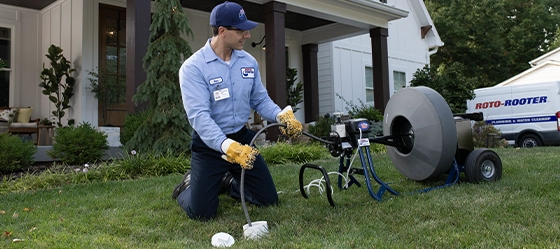
Under most of the Las Vegas Valley there is a layer of ground that behaves closer to weak concrete than to soil. Caliche forms where carbonate leaches down through desert ground and cements everything below it into a pan, and here it turns up anywhere from a few inches down to several feet, in seams that change from one property line to the next. It is the single fact that shapes sewer excavation in this valley, because it changes what digging means.
The Footage That Turns a Cleaning Job Into an Excavation
Nothing gets opened on the strength of a symptom. A camera inspection runs the line first and the recording is what authorizes the work. What ends the cleaning conversation is structural: a collapsed section, a joint offset far enough to catch solids, a bellied run holding standing water at its low point, or root mass entering through a break that returns after every clearing. A line that repeats the same blockage at the same measured distance is telling you about the pipe itself.
Two generations of buried pipe run under this city. The older streets close to downtown were built out through the boom decades of the middle of the last century, and those laterals are vitrified clay or cast iron sitting under yards that have been irrigated ever since. The subdivisions that filled the rest of the Las Vegas Valley floor carry PVC, and they fail for different reasons: bedding, grade and what happened in the trench on the day the pipe was laid. The camera settles which of those two conversations you are actually in, and it does it before anybody quotes a repair.
Sewer Line Replacement Under a Concrete Drive
A great many laterals in Las Vegas leave the house and run under a concrete approach, a paver court or a slab patio on their way to the street. That surface is the reason the method question gets decided early. Concrete over cemented ground is a saw cut, a break-out and a pour to put right, and the pour is a separate scope from the pipe. Where the line is deep enough, sound enough at both ends and made of a material that will take it, a trenchless approach can leave the drive standing. Where the camera shows a collapse, that option closes and an open cut is the only honest answer.
Operated as an Independent Contractor - All available services, hours of operations, pricing structure, and guarantees may vary by location
Serving the entire Las Vegas metro area, Including:
Counties in the Las Vegas Metro Area
Who Owns the Pipe Once It Leaves the Property
The buried run between a house and the public system is the private sewer lateral, and in most places the owner is responsible for it along its whole length, in some cases all the way to the connection at the main. Where that responsibility ends is set by the jurisdiction you are in, and Clark County and the cities inside the Las Vegas Valley do not all draw the line in the same place. The honest answer is that your municipality decides, the camera tells us where the defect sits, and the two together settle who is doing what. Roto-Rooter works up to the property boundary and does not perform work on the municipal main.
Will the Concrete Drive Have to Come Up?
Sometimes, and the camera answers it before the estimate does. Where the defect sits under an unpaved side yard, the trench is opened in desert landscaping and the surface goes back as decomposed granite, drip line and fabric. Where it sits under a poured approach or a walk, that surface has to be cut and broken to reach the pipe. Backfill, compaction and a clean edge on the cut are part of the excavation. Replacing the finished surface itself, matching a colored pour, resetting pavers or rebuilding planting, is scoped on site, and getting that scope written down before the work starts is what keeps the end of the job from being a surprise.
Compaction, Settlement and the Season After the Work
This is where cemented ground makes a real difference to a homeowner. Native caliche comes out of a trench as broken slabs and dust, and pushing that back in loose leaves voids that close up over the following months, which is how a trench line shows up across a yard as a shallow scar a season later. The trench gets bedding under and around the new pipe, then backfill placed and compacted in lifts, with the surface built back to grade. Where the line runs under a drive or a walk, compaction under that surface matters more than anything you will see on the day.
- Bedding first: the new pipe is set on graded material so it carries a continuous fall and nothing rests on a point load.
- Lifts, then compaction: backfill goes in and gets compacted in stages, because one deep push of loose spoil is what settles later.
- Surface separated from structure: the trench is brought back to grade as part of the work, and the finished surface on top is its own scope.
- A second look is fair: after the first heavy monsoon runoff southern Nevada gets each summer over a fresh trench, a walk of the line is a reasonable thing to ask for.
Living With the Line Until the Work Is Scheduled
Between the camera and the dig, a household still has to use water. Keeping wipes, grease and heavy paper out of the line buys real time on a run that is already compromised, and a failing lateral usually gives warning through slow floor drains and gurgling at the lowest fixture. If it backs up before the excavation is scheduled, that is an emergency plumber in Las Vegas call, and Roto-Rooter answers those 24/7, 365 days a year. For anything else the franchise handles across the Las Vegas Valley, start here.
Request an On-Site Sewer Line Assessment in Las Vegas
If a line has been cleared more than once and keeps coming back, the next useful step is footage. Call 702-931-3831 to get a camera on the line, or schedule online and pick a window that works. Roto-Rooter is fully licensed and insured, provides on-site estimates before any work begins, and the crew that reads the camera is the crew that does the excavation.

When Trenchless Pipe Bursting Works in Cemented Ground
Locating Every Buried Utility Before the Hammer Starts
