Sewer Line Excavation and Trench Repair in Antioch
Key Takeaways: What Decides Where a Sewer Line Fails in Antioch
- A line that backs up again a few weeks after it was cleared is usually saying the pipe has lost its shape, and shape is something a cable cannot restore.
- Grading matters here: much of the housing south of the old river town sits on pads that were cut on the uphill side and filled on the downhill side, and a sewer lateral crossing that boundary can settle into a low spot that holds water.
- Clay soil moves on a schedule in this part of California, drying and pulling away through the long rainless stretch and taking water back up when the winter storms arrive, which works pipe joints loose over the years.
- Camera inspection decides the job. The footage shows the collapse, the offset joint, the roots or the belly, and it also shows whether trenchless is realistic.
- Trenchless has conditions. Pipe bursting and lining follow the path the old pipe already takes, so a run that sags because the ground under it dropped will still sag once the new pipe is in.
- Utility locating comes before any dig. Gas, electric, water and telecom get marked, and no ground opens until that is finished.
- Roto-Rooter is fully licensed and insured, handles the permit and inspection process, and gives you an on-site estimate before any work begins.
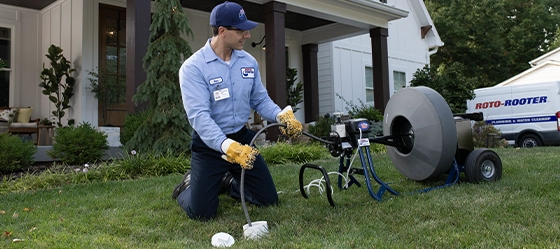
Sewer line excavation in Antioch is usually a conversation about the ground the pipe sits in. The old grid down by the water was laid out when this was a coal and shipping port, on deposit left by the San Joaquin River. Almost everything that spread south and east afterward was built on rolling terrain that had to be graded flat before a foundation could go down, so the pad under the house was cut away on one side and built up with fill on the other. The lateral runs straight across that boundary. Fill compresses over the years, undisturbed ground holds still, and the pipe between them ends up carrying a low point it was never laid with.
That low point is a belly, and it is the most common reason a line in Antioch keeps backing up after it has been cleared. Water stands in the sag instead of running through it, solids drop out of suspension where the flow slows, and the blockage rebuilds itself in the same place. A cable punches through and buys a few months. The next call comes anyway.
The older streets down in the original town carry a different story. Those laterals are the longest-serving pipe anywhere in Antioch, vitrified clay was the standard material when most of them went in, and clay fails at its joints. Between the two halves of town, this market gives a crew about every failure mode a residential sewer line in California produces.
A Camera Comes Before Any Excavation
Nobody should dig on a hunch. A camera inspection puts the real condition of the sewer lateral on a screen, with footage and a located depth, and that is what turns a guess into a decision you can check. Four findings end the argument about more cleaning: a collapsed section, a joint offset far enough to catch solids, roots that have opened a joint and grown into the bore, and a belly holding standing water between cleanings.
Why does a sewer line belly, and when does that mean excavation?
Pipe is laid on a prepared bed at a designed fall. If the material under a stretch of that bed compresses, the pipe follows it down and the fall goes flat or reverses. On a graded lot the compression is rarely even, because engineered fill and native ground respond to the wet season differently. Antioch adds a second push. Summers here run hot and rainless for months, which is the half of the year when the clay across the south side of town is pulling away from everything buried in it. Then the rain arrives in a concentrated winter window and the same clay takes the water back and swells. The material around an Antioch sewer lateral is moving every single year on that cycle. Enough cycles opens a hairline gap at a joint, roots find the gap, and the spot that moved becomes the spot that fails.
Roots are the other half of the story on the older blocks. Mature street trees across Antioch have had decades to find any joint that has opened, and a root mass sitting in a clay lateral holds paper and grease the way a filter does. The camera separates the two cases. Roots through one joint are a repair at that joint, while a line taking roots at every joint along its length has reached the end of its working life.
None of that is visible from the surface, which is why the footage matters more than the symptom. Before a dig is recommended, the inspection should have established four things.
- Location and depth: where the defect sits along the run, and how far down.
- Condition of the whole run: whether one section failed or the line is at the end of its service life along its length.
- Cause: roots through a joint, a crushed section, or a bed that dropped, since each points at a different repair.
- Access: what is on the surface above the defect, and what a machine can reach.
Serving Antioch and surrounding communities, Including:
Counties in the Antioch Area
The Lateral, the Main, and Where Excavation Stops
The sewer lateral is the pipe carrying waste away from the house and into the public main. On most properties the owner is responsible for the lateral and the municipality is responsible for the main, but the point where one becomes the other is set locally. Antioch sits inside Contra Costa County, and the handover point belongs to whichever authority owns the main under the street. Some jurisdictions hand the owner everything as far as the connection at the main. Others take responsibility at the property line or at the curb. Your municipality decides that, and the crew confirms it for your address before anything is scoped. Roto-Rooter works on the private side of that line. Municipal main work belongs to the utility and we do not take it on.
What the Work Looks Like on a Residential Street
The run is located and marked, the utilities are cleared, and the ground is opened only across the length the footage justified. Spoil comes out and is set aside, the failed section is removed, the bed is rebuilt to grade, and the new pipe is laid and tested before anything goes back. Backfill then goes in as compacted lifts so the ground does not settle into a fresh low spot a year later. Compaction is the part a homeowner never sees and the part that decides whether the repair holds. On the expansive clay across Antioch it earns extra attention, because the soil behavior that moved the first pipe is still in the ground, and a loosely filled trench in this part of California will find the same low spot the original bed did.
Keeping the House Running While the Repair Is Booked
A property with a failing lateral still has to work in the meantime. Roto-Rooter is available 24/7, 365 days a year, and a crew can clear the line to keep water moving while the replacement is scheduled and permitted. The company has been solving drain and sewer problems since 1935, and the plumbing peace of mind at the end of this is a line that stops asking for attention. For the rest of what we handle in this market, start at the Roto-Rooter page for Antioch.
Schedule Sewer Line Excavation and Repair in Antioch
If a line in Antioch has been cleared more than once and keeps coming back, the useful next step is to see inside the pipe. Call 925-752-9438 to book a camera inspection with Roto-Rooter, or schedule online, and you will have an on-site estimate in hand before any work begins.

Open-Cut and Trenchless Sewer Line Replacement, and What Decides Between Them
Locating, Permits and the Ground You Get Back
