Sewer Line Excavation and Replacement in Alexandria
Key Takeaways: What an Excavation Costs You Above Ground
- The surface is half the job in this city: brick walks, historic streetscape and small front gardens mean what has to be taken up and put back matters as much as the pipe underneath.
- A camera inspection has to justify the dig: a collapse, a severe offset, a belly holding water or a broken joint, not a line that simply needs cleaning.
- The ground is not the same across town: this part of Virginia sits astride the Fall Line, with hard crystalline rock toward the west and coastal sands and clays toward the river, and trench work behaves very differently in each.
- Trenchless is conditional: pipe bursting and cured-in-place lining need the right host pipe, depth and access at both ends, and the inspection decides whether they are on the table.
- Utility locating comes before any excavation, and on blocks that have been built and rebuilt for centuries there is a great deal down there.
- Responsibility changes somewhere between the building and the main, and where it changes is decided by the jurisdiction rather than by a contractor.
- Roto-Rooter is fully licensed and insured, handles the permit and inspection process, and provides on-site estimates before any work begins.
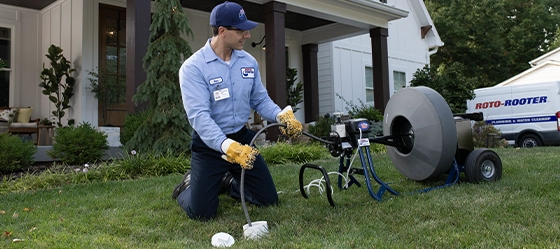
Sewer line replacement is the repair nobody plans for, and in Alexandria it comes with a complication most places do not have. The pipe is usually the cheaper half of the problem. What sits on top of it, a brick walk, a slate path, a small walled garden, a shared alley, a street with protected character, is what turns a straightforward excavation into a job that has to be thought through before a machine arrives.
Proving the Dig Is Necessary Before Anyone Touches the Ground
The first obligation is to establish that the line genuinely cannot be restored from the inside. That means a video camera inspection, and it means seeing the footage yourself. A pipe that is blocked but sound gets cleaned, and that work lives with Drain Cleaning in Alexandria. A pipe that has collapsed, dropped out of alignment at a joint, developed a belly that holds standing water, or broken open around a root mass is structural, and no amount of cable or water restores it.
The camera also gives a measured distance to the defect, which is the number the rest of the job hangs on. On a tight Alexandria lot, whether the fault sits under the front garden, under a brick path or out under the public walk changes the permit, the method and the restoration all at once.
Two Different Grounds Inside One City
Alexandria straddles the Fall Line, the boundary where the hard crystalline rock of the Piedmont gives way to the softer sediments of the coastal plain. Toward the western side of the city, trenching can meet rock at shallow depth, which is slow, noisy work and sometimes rules out a method entirely. Toward the river the ground is sand, silt and clay, which digs easily and holds a trench wall badly, so shoring and careful backfill matter more. Groundwater sits closer to the surface down there too, and a trench that fills has to be dewatered while the work goes on.
The practical consequence is that two Virginia properties a couple of miles apart, with the same failure in the same kind of pipe, can be quoted differently for reasons that have nothing to do with the pipe. Anyone giving you a number before they know which ground you are on is guessing.
Serving Alexandria and surrounding communities, Including:
Counties in the Alexandria Area
Where Does My Responsibility for the Sewer Lateral End?
This is the question that decides who pays for what, and it is one where a confident wrong answer causes real damage. The general framework is the same across Virginia: the property owner is responsible for the lateral serving the building, and the municipality is responsible for the main. What varies, and it varies more than people expect, is the treatment of the length of lateral that runs under public ground between the property line and the main. Some jurisdictions leave all of it with the owner. Others take it on at the property line or at the curb. Your municipality decides, and the answer should come from them before any scope is agreed that crosses the boundary. Roto-Rooter does not work on the municipal main.
What Roto-Rooter can give you is the evidence to have that conversation: camera footage, a measured distance from a known reference point, and a written description of the defect. In Alexandria, where responsibility questions can turn on a few feet of pipe, that documentation is worth having before anybody starts arguing about it.
Old Pipe, and What the Camera Usually Finds
The housing stock here spans a very wide range, and so do the laterals under it. In the oldest blocks the sewer connection may have been rebuilt more than once and still contain a length of vitrified clay with a joint every few feet. Mid-century sections of Alexandria carry cast iron that has scaled and thinned from the inside, and a specific postwar window in Virginia and across the mid-Atlantic used bituminous fiber pipe, which deforms into an oval and delaminates as it ages. Knowing which one is under your garden changes the conversation entirely, because clay usually fails at a joint, cast iron fails along its length, and fiber pipe fails by losing its shape.
Tree Canopy, Frost Depth and the Slow Failures
Two more local drivers show up repeatedly on Alexandria excavation work. The first is canopy. Streets here carry substantial mature trees, and a root system that has spent decades alongside a jointed clay lateral will find any joint that has begun to weep. That is a slow failure, and it typically presents as a line that needs cleaning more and more frequently until a camera shows the joint has broken open rather than merely leaked.
The second is depth. This part of Virginia gets real winters, so services are buried below the local frost depth, and that sets how deep the trench has to be before any work is done at all. Depth drives shoring, spoil volume and the size of machine that has to reach the trench, which is one more reason a narrow Alexandria site is a different job from a suburban front yard with a driveway a truck can park on.
Brick, Slate and What Restoration Really Means
Be clear about this in advance rather than afterwards. Backfill and compaction are part of the excavation, and getting the compaction right is what stops the surface sinking six months later. Putting a lawn, a brick walk, a paved courtyard or a public sidewalk back to the state it was in is a separate scope, and in a historic streetscape it can involve materials and standards the jurisdiction specifies rather than ones a contractor chooses. Roto-Rooter will tell you what the job includes and what it does not before the work starts. Anybody promising an Alexandria brick walk that looks untouched has not priced relaying brick.
Request a Sewer Line Excavation Estimate in Alexandria
Roto-Rooter has been working on sewer lines since 1935, and the team covering Alexandria runs camera inspection, open-cut excavation, pipe bursting and spot repairs, so the recommendation is driven by the line rather than by the one method a crew owns. Roto-Rooter is fully licensed and insured, works 24/7, 365 days a year, handles permitting and inspection, and provides on-site estimates before any work begins. Call Roto-Rooter to get a camera on the line, or call 703-525-3014 or schedule online. For everything else the local team handles, see Roto-Rooter in Alexandria.

Open-Cut Versus Trenchless on an Old, Tight Block
Utility Locating, Permits and the Historic Surface
